Nutrition Tips for Your Donkeys
Thanks to a wonderful show of solidarity on Instagram, in November 2025 I met Auriane, a holistic nutritionist for horses, cats and dogs and the founder of Inner Wild. We very quickly decided to collaborate and jointly produce a post offering nutrition tips for donkeys. You can find out more about Auriane’s work at the bottom of this article.
Understanding the specific nutritional needs of donkeys
Donkey nutrition relies on a precise understanding of their specific needs, which often differ from those of horses, and requires a thoughtful approach to maintain their health, well-being and longevity.
Donkeys are animals that have evolved in arid, resource-poor environments. Their bodies are designed to extract maximum energy from high-fibre, low-calorie forage.
A diet based on low-nutrient, high-fibre forage
Their diet should therefore consist mainly of mature forage, such as late-cut hay or sufficiently dry silage, as these forages have a lower energy content whilst providing a high proportion of long-fibre, which is essential for the proper functioning of their digestive system.
In most cases, good-quality forage is also sufficient to meet a large proportion of their essential vitamin requirements, making the administration of non-targeted vitamin supplements unnecessary, and sometimes even risky.
Respecting the donkey’s natural feeding rhythm
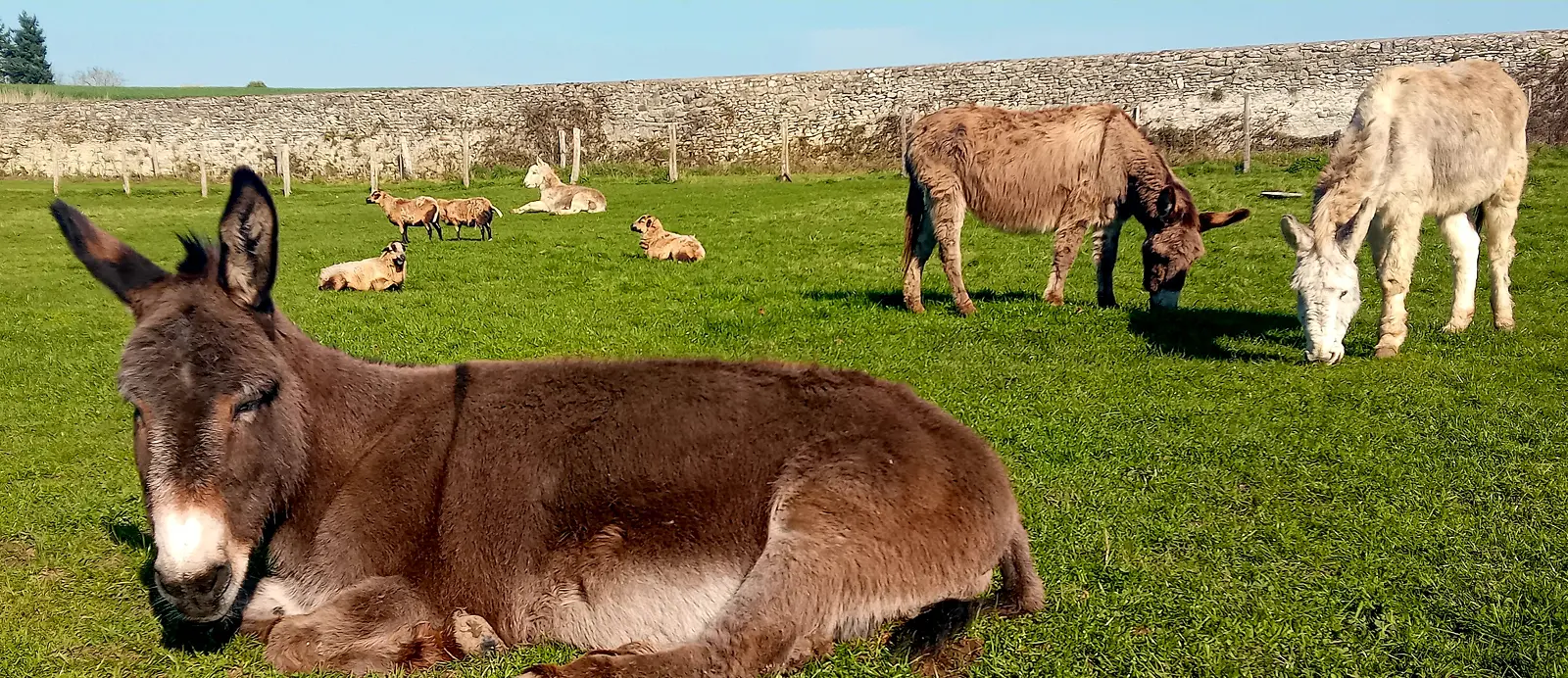
At the same time, it is essential to respect their natural instinct to feed slowly and continuously: donkeys are almost constant grazers, physiologically designed to consume small amounts of plant matter throughout the day.
To accommodate this behaviour and prevent boredom, stress or the development of destructive behaviours, it is recommended to provide them with access to trees, hedges or safe branches from non-toxic species. These elements not only serve as a form of environmental enrichment but also contribute to the natural wear of their teeth and the maintenance of regular digestive activity.
Health alert: hyperlipidaemia in donkeys
Donkeys are particularly susceptible to hyperlipidaemia, a serious metabolic disorder that can occur, in particular, in cases of:
- overfeeding,
- stress,
- or a sudden reduction in food intake.
Their bodies react very quickly to energy imbalances. Careful monitoring of their diet and body condition is therefore essential.
Regular assessment through observation and palpation allows for the early detection of weight changes and helps prevent complications.
Supplementation: simplicity and caution
Donkeys generally only need free and constant access to a natural salt block, as this is often sufficient to meet their basic mineral requirements without the risk of over-supplementation. However, if there is any doubt about a possible deficiency, particularly in the event of:
- a change of pasture,
- a change in forage quality,
- suspicious symptoms such as a dull coat,
- a drop in energy levels,
- or an unusual appetite,
It is important to consult a vet to carry out a precise blood test before starting any mineral or vitamin supplementation.
The benefits of analysing the pasture
This caution is all the more important as certain deficiencies can resemble other conditions, and the excessive administration of certain minerals can be just as problematic as a deficiency.
A pasture analysis may be considered to better understand the botanical and mineral composition of the areas where donkeys graze, as these directly influence the nutritional quality of their daily diet.
If the analysis reveals a nutritional value that is too high or a mineral imbalance, it may be necessary to supplement or replace part of the pasture with mature hay, which is particularly suited to the actual needs of donkeys.
Supplementing the diet in winter
In winter, and especially for older donkeys, you can supplement their diet with a mixture of grains (barley and oats, as donkeys do not eat wheat) several times a week.
In summary
- Feeding a donkey optimally is not about enriching its diet, but rather respecting its physiology by prioritising low-calorie forage, a continuous supply of fibre, an environment conducive to natural grazing, and careful monitoring of its general condition.
- Good nutritional management is based on simplicity, moderation and a deep understanding of what the donkey really needs to stay healthy: plenty of fibre, very few unnecessary calories, and a holistic approach focused on prevention rather than intervention.